Your AI agent works on launch day. You demo it, everyone nods, and then… it plateaus. It calls the wrong tool on Tuesdays, loses users in long conversations, and quietly gets worse as your data drifts — and you find out about it from a support ticket, not a dashboard. That plateau is exactly what DigitalOcean Agent Learning, announced on October 12, 2026, is built to fix. It turns agent interactions into a self-improvement loop — record what the agent does, flag where it falls short, test the fix before customers see it — running on one cloud instead of four vendors stitched together.
This is a news-plus-explainer post, not a how-to: the product is in preview, so there is no step-by-step setup to walk through yet. What you get here is the honest version — what each piece does, what you can touch today, and the caveats DigitalOcean itself buries in the fine print. Facts verified October 13, 2026 against DigitalOcean’s official announcement.
Why your agent plateaus after launch
DigitalOcean’s own announcement nails the diagnosis, and it matches what most teams actually experience. Once an agent is deployed, making it better is hard because every piece of the job lives somewhere else. The record of what the agent did sits in a monitoring tool that shows whether systems are up — not why the agent called the wrong tool or lost a user mid-task. Fixes are usually untested prompt tweaks, so the first person to notice a regression is a customer. Real model improvement means exporting production data to a training vendor and wiring together four or five tools, so it happens once a quarter, or not at all.
If that sounds familiar, you already understand the pitch for DigitalOcean Agent Learning. The question, as DigitalOcean’s Chief Product and Technology Officer Vinay Kumar put it, has changed:
“The question has changed from ‘can we launch an agent’ to ‘does our agent get better with every run… We built Inference Engine so agents could think, Managed Agents so they could act, and now Agent Learning Services and Agent Data Services so they can improve, on one open cloud and on the customer’s own data.”
What DigitalOcean Agent Learning actually is
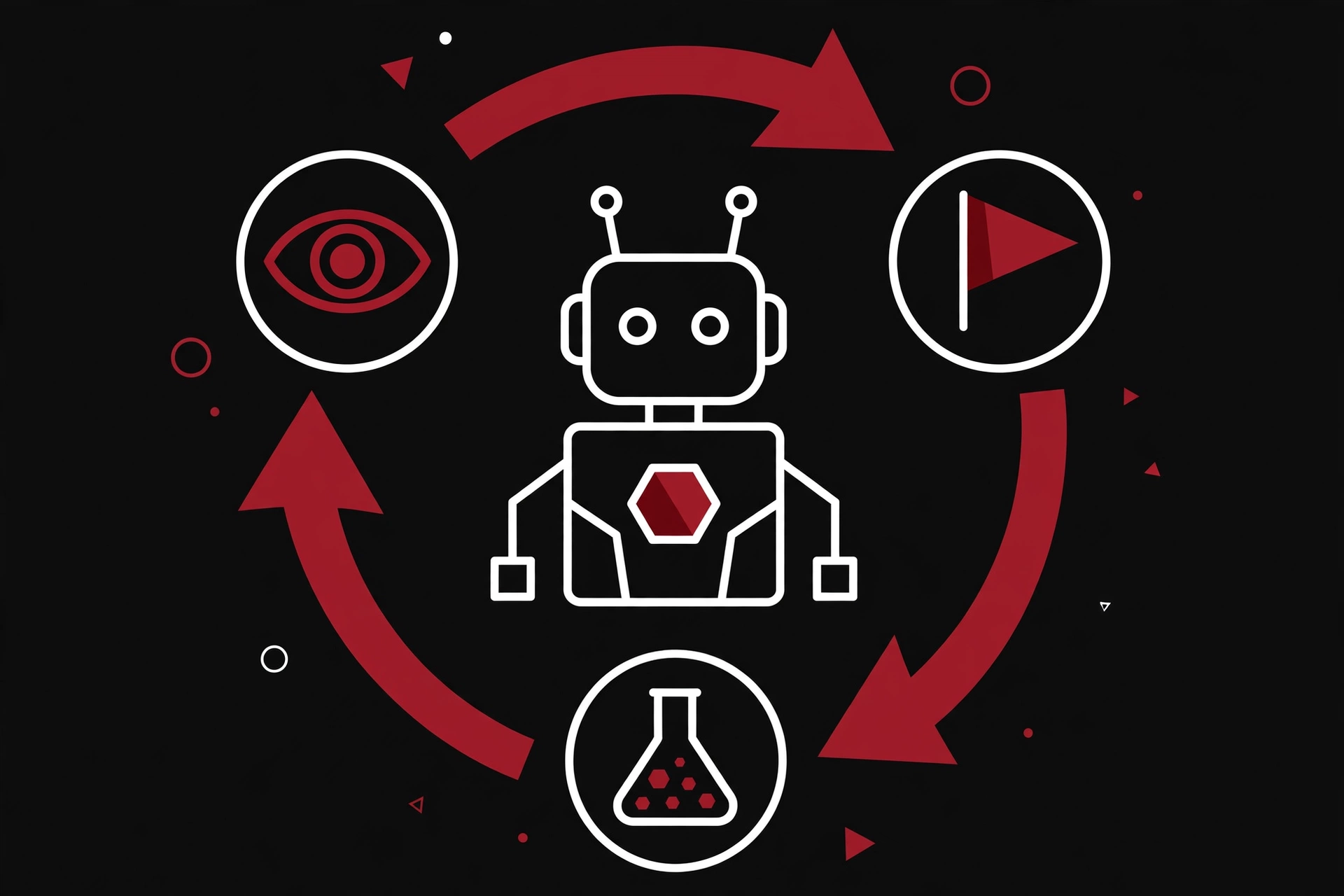
Agent Learning Services are three products that work as one loop: Insights records what an agent does, Signals flags where it falls short, and Evaluations & Simulations test a change before customers see it. Each stage feeds the next, which is why DigitalOcean calls it “recursive self-improvement.” Here is what each piece does in practice.
1. Insights: the flight recorder
Insights records every step an agent takes — the full execution trace of a session. On its own, that is table stakes; any tracing platform does this. Its job in the loop is to produce the raw evidence everything else works from.
2. Signals: the part that actually matters
Signals flags the sessions that matter: where the agent stalled, looped, lost the user, or failed. This is the piece most teams lack. Raw traces accumulate by the million; nobody reads them. Signals is supposed to surface the failures worth learning from — a session that ended in a loop, a task where the agent called the same tool five times, a conversation the user abandoned. That flagged evidence becomes a proposed change.
3. Evaluations & Simulations: test before the customer does
Evaluations & Simulations test changes ahead of real users with realistic conversations built from the flagged sessions. In other words: take the sessions Signals flagged as failures, turn them into test cases, and run your modified agent — new prompt, new model, new tool config — against them before shipping. That is the core discipline of modern agent development (evals as a test suite), and it is the stage almost everyone skips because building the harness takes a week. DigitalOcean is trying to make it the default.
The Inference Router angle: the loop is already running on models
There is one part of the loop that is already live in a narrower form. DigitalOcean’s Inference Router — its model-routing layer — now picks the best-scoring model for each task, optimized for cost, quality, or the team’s own evaluations, and re-runs those evaluations as new models ship. The pattern is: your eval results decide which model handles which task, and the router keeps re-checking as new models arrive.
This is quietly the most interesting technical claim in the announcement. It turns evaluations from a one-off report into a live routing input — if you score two models on your own tasks, the router can send each request to whichever scores better for that job. The announced plan is to extend the same automated loop to agent workflows, but for now that stage still has human approvals in it. Which brings us to the caveats section.
DigitalOcean Agent Data Services: the data layer underneath
The learning loop runs on top of a second product, Agent Data Services — the managed data layer that feeds it. The idea: every piece of a company’s data becomes agent-ready the moment it arrives. Video gets transcribed and described, documents get read and indexed, logs and agent sessions get assembled with configurable redaction controls for sensitive details, and all of it is searchable by meaning in a single call. It lands in one catalog, logically isolated per customer, with governance so only authorized people and agents can reach each piece of data.
DigitalOcean’s official blog breaks the machinery into four pieces: Managed Data Flows that process, vector-index, and enrich new data as it arrives; a Data Catalog where structured records and vectors sit together with lineage back to the source; query access through standard SQL and developer APIs (no separate vector database to provision); and scoped access per workspace with roles, API tokens, and audit logging. Agent Learning Services are built on it — Signals writes sessions into it, and the router’s optimizer draws training and test data from it.
One detail worth calling out: the optimizer only draws training and test data from your sessions “where the customer expressly opts in.” Your agent’s traces do not silently become training data. In the current climate — where model vendors have had to answer uncomfortable questions about whose data trains what — that opt-in line is doing real work. Treat it as a promise to verify in the docs rather than assume forever, but it is the right default.
What you can actually use today — and the honest caveats
This is the section that separates a marketing recap from a useful post. Here is the availability picture straight from the announcement:
- Public preview: Agent Learning Services — Insights, Signals, and Evaluations & Simulations. Available today.
- Private preview: Inference Router optimizer and Agent Data Services. You have to request access.
- Not yet: the fully automated workflow loop. Today the recursive improvement runs on models; extending it to whole agent workflows, with human approvals augmented or replaced, is a stated plan, not a shipping feature.
- Live demo: DigitalOcean is demonstrating the services at its Open Intelligence Summit in San Francisco on October 13, 2026 — today, as this post goes out.
And now the fine print, which DigitalOcean states plainly and you should read plainly:
- Preview terms: preview services are provided as-is, are not supported for production workloads, may change, and may never become generally available or be discontinued. Do not architect your production agent around this yet.
- No pricing: the announcement discloses no pricing for any of the new services. Cost is the single biggest question for indie builders and small teams, and it is currently unanswerable.
- The “one platform” claim is a work in progress: DigitalOcean positions itself as one of the few clouds where agents can run, learn, and improve on one platform — Inference Engine for thinking, Managed Agents for acting, now learning and data. That is a roadmap pitch; the private-preview pieces are the load-bearing parts of it.
- The customer proof point: Amplitude’s Spenser Skates is quoted saying DigitalOcean Managed Agents powers their Amplitude Wave product — they “choose the model for each task based on the results it delivers, not just its cost.” That is a model-routing endorsement, not an Agent Learning endorsement; do not read more into it than that.
Doing the same thing without DigitalOcean
None of the three loop stages is a new invention. The established open-source and commercial agent-observability stack — LangSmith, Langfuse, Braintrust, Arize Phoenix, and a long tail of newer tools — already gives you tracing (Insights), dataset curation from production failures (Signals, roughly), and offline evaluation harnesses (Evaluations). What DigitalOcean is selling is integration: those three stages as one loop, on the same cloud as your compute and inference, with a managed data layer underneath instead of the transcription jobs, indexing pipelines, and sync scripts you would otherwise build and maintain yourself.
Whether that integration is worth betting on depends on where your agents already live. If you are running on DigitalOcean’s Inference Engine and Managed Agents, the loop is a natural extension. If your agents run elsewhere, adopting Agent Learning Services means moving your improvement infrastructure onto a platform your agents do not run on — which is exactly the fragmentation the announcement complains about. The honest framing: this is a platform play, and its value is proportional to how much of the DigitalOcean stack you already use.
Should you care?
If you are a solo dev with one agent in production: the concept matters more than the product right now. The loop — record, flag, test — is the discipline that separates agents that improve from agents that rot, and you can implement a rough version of it today with an observability tool and a folder of eval cases. If you are on DigitalOcean and shipping agents to real users: join the public preview of Insights, Signals, and Evaluations & Simulations, because the difference between “we tweaked the prompt and hope” and “we tested the tweak against 200 failed sessions” is the difference between engineering and guessing. And if you are evaluating clouds for an agent-heavy product: the private preview of Agent Data Services is the piece to watch — the learning loop is only as good as the data foundation under it, and that is the part DigitalOcean says is engineered deliberately.
Further Reading & References
- DigitalOcean Launches Agent Learning and Data Services for Recursively Self-Improving AI Agents — official press release (investors.digitalocean.com). Every availability, product-description, and forward-looking claim in this post traces back to this document.
- Introducing DigitalOcean Agent Data Services: The Data Foundation for Agents — DigitalOcean’s official blog with the under-the-hood breakdown (Data Flows, catalog, SQL/API access, governance).
- Business Wire release — the original wire copy of the announcement, October 12, 2026.
- DigitalOcean Launches Agent Learning and Data Services — YourTechDiet — independent coverage of the launch.
- DigitalOcean Agent Learning Services Turn Agents Into Self-Improvers — GenZ NewZ — October 12, 2026 coverage framing the plateau problem.
- AI Agent Observability: Logging, Tracing, and Debugging Explained — MachineLearningMastery (2026) on the observability/eval tooling landscape, for the roll-your-own alternative.
- AI Observability Tools: 8 Platforms for Tracing AI Agents in 2026 — comparison table of LangSmith, Langfuse, Braintrust, Phoenix, Opik, Weave, Datadog, and AgentOps.
- davila7/agents_otel_data — evidence-based benchmark of agent observability platforms’ write and read APIs (GitHub), if you want to compare the roll-your-own options on data rather than marketing.
- AI Developer News: Week Ending October 13, 2026 — this launch covered in this morning’s roundup on HowToShipIt, alongside the rest of the week’s agent-infrastructure news.
- Best AI Coding Model in 2026: What the Benchmarks Actually Say — relevant reading on the model side of the loop: benchmark scores are exactly the kind of evidence an Inference Router routes on.